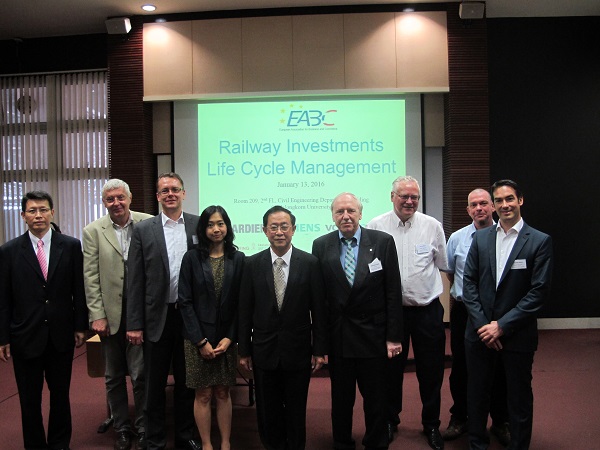
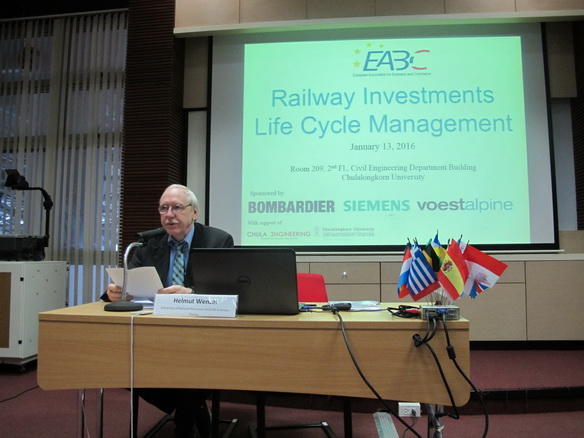
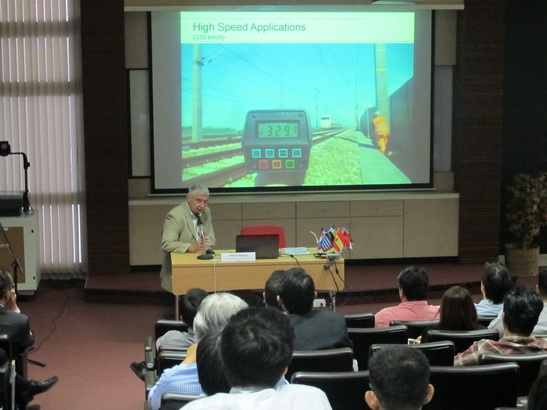
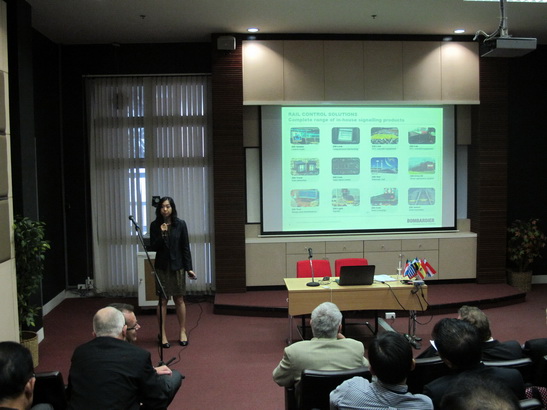
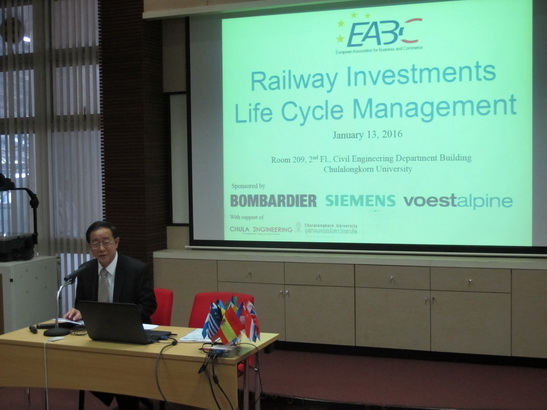
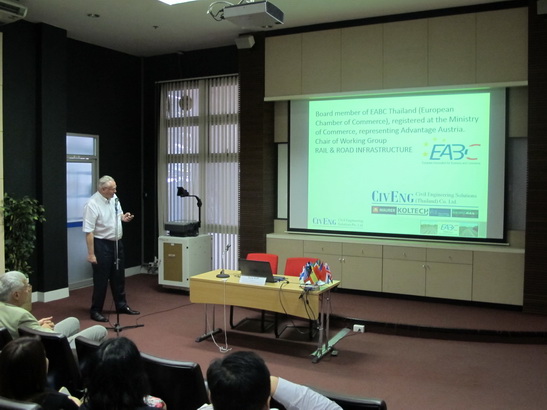
On 13 January 2016 at the civil engineering building, Chulalongkorn University, EABC Rail and Road Infrastructure Working Group in collaboration with the Faculty of Civil Engineering, Chulalongkorn University organized a seminar entitled “Railway Investment Life Cycle Management”. This seminar was held as a part of EABC’s efforts to bringing European state-of-the-art-knowledge focusing on life cycle aspects of railways system to share with Thailand.
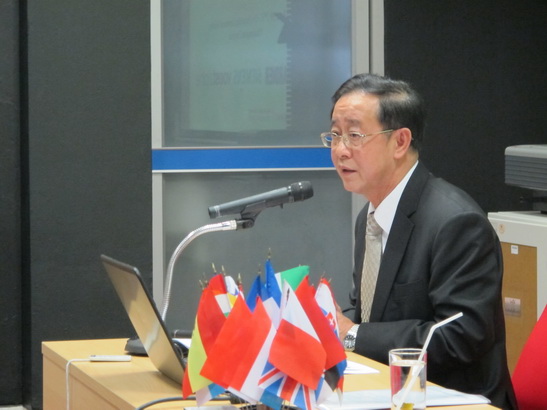
On this occasion, the Minister of Transport H.E. Mr. Arkhom Termpittayapaisith presided over the opening ceremony and delivered a speech emphasizing the importance of Thailand’s railway project as a key driving Thailand towards a regional hub of railway network in ASEAN. Also, he mentioned that as a second railway life cycle following the first cycle initiated by King Rama V is approaching, maintenance and safety standard are becoming increasingly significant. To promote the achievement in railway aspect, the Minister of Transport hereby expressed his support to the EABC activities in collaboration with the Office of Transport and Traffic Policy and Planning (OTP).
The seminar was divided into two sessions covering six presentation topics as follows;
In life cycle engineering (LCE), structural assessment process comprises (1) life cycle analysis (2) life cycle costing and (3) life cycle management. When done properly with information acquired since the beginning of structuring stage and assistance of a tailored and modular software solution, this ageing/durability process model would help avoiding a premature investment.
Alternative to a traditional approach of maintenance management is the balanced maintenance strategy providing defects repair part by part to allow regular operation of the train. This approach is condition-based, beginning with recording of condition based data, integrating data into computerised maintenance management system (CMMS), and systematically use of the stored data for planning of maintenance procedures.
To reduce life cycle cost of railway, communication-based train control (CBTC) is considered one approach as the system utilizes high-resolution train location determination, bidirectional train-to-wayside data communication, and train-borne and wayside processors capable of safety, optimization, and supervision functions. Via this system, life cycle cost is reduced through less wayside equipment and cables.
The design of rolling stock can contribute to reducing life cycle cost by featuring less weight, innovative floor, efficient traction technology, LED lighting technology, and electro dynamic brake to standstill, which result in less energy consumption.
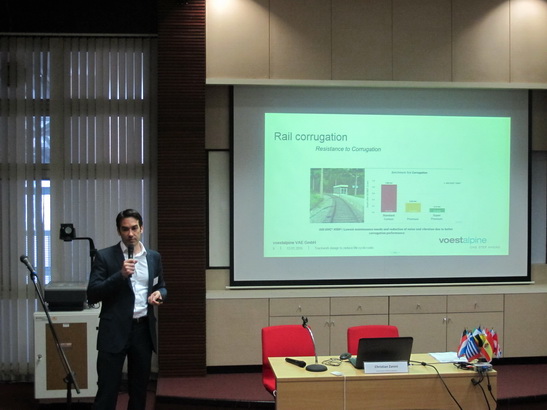
Life cycle cost is influenced by rails materials, turnouts design, and signalling, therefore, selection of optimized rail materials, advanced turnout technology, and switch condition monitoring (SCM) conducting preventive maintenance are proven significant.
Monitoring railway structure and identifying its condition are crucial to decision support whether or not to take action as legal issue is involved. The monitoring offers many advantages; finding ultimate load, determining fatigue life, designing targeted inspection programme, and quantifying life extension. By this method, cost is reduced without sacrificing safety.
Interaction between the deck of the railway bridge and the track is crucial to railway life span, thus, selection of track and bearing are considerable. However, the adoption of international standard of bridge bearings EN 1337 still requires a third party quality control.
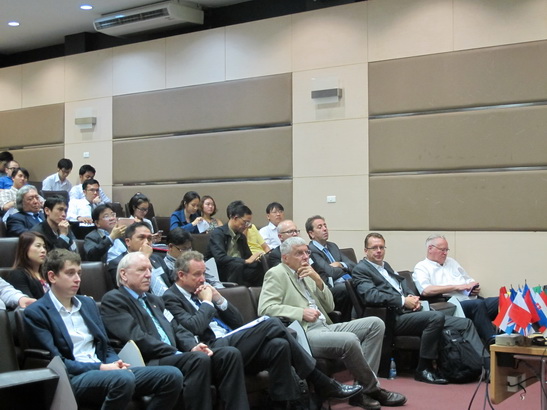
During Q&A session, questions received from a floor covered a broad range of issues, including (1) type of data required for life cycle management system (2) way to control life cycle cost (3) selection of bearing considering impact on movement and (4) measure on structural movement. In this regard, answers were provided respectively as follows; (1) type of data required is not limited as the more the data provided, the better the performance become (2) penalty should be included as means to control manufacturers (3) bearings should be selected based on different bridge system and (4) measuring structural movement by sensor is based on vibration behaviour.
The seminar was successful considering broad public interests received from more than 70 participants, ranging from Thai government officials, railway operating engineers, consulting engineers, European Union Delegation to Thailand, EABC members, as well as university students.
To download the presentations, please click on the followings;
Photos 



 EU Delegation to Thailand